• About “The Salamander’s Quill”
  • Goals and Definitions
  • Copyright
  • Resources and Library
  • I Like What I Do Because…

The Salamander's Quill

~ We hunt the white whale, and we'll no be goin' back!

The Salamander's Quill

Author Archives: André J. Powell

Elizabeth Moon’s Oath of Gold

10 Wednesday Apr 2013

Posted by André J. Powell in Musing, Reading, Storytelling, Writing

≈ 1 Comment

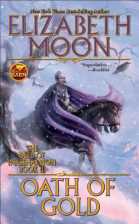
Oath of Gold     I enjoyed Oath of Gold, the third in “The Deed of Paksenarrion” trilogy and getting to know Elizabeth Moon’s early fantasy side. It has been remarkable to watch the evolution of her writing style. She seemed to have found her stride during this the final chapter of Paks’s story and Paks truly stepped out to become round and dynamic. The dialogue felt more authentic and the predominantly human versus human conflicts extremely satisfying.
     On that note, a thought came to me as I finished the book. Was the dialogue an issue for me because Moon was still developing her skill or was it a purposeful device to support Paks growing from a young country girl naïve in the ways of world to a full grown woman tried, tested and sharpened by harsh experience? As I reflect on the trilogy as a whole, I plan to keep this thought in mind when I next read a fantasy. To answer the question here would take a second read of the trilogy and my reading list is too long for that. Another tantalizing tidbit gleaned from Moon’s website is the suggestion that trilogy was first written as a single long story, broken up “…for practical purposes…” I can only imagine this means for publications sake. Did Moon’s skill evolve more organically then rather than in stages? Or are my own observations too amateur and arm-chair in nature?
     As intended, Moon’s exploration of the military-religious mind set was thought provoking. I am always torn between wanting the authentic ring of the ever-compromising human mindset and a craving for a clear cut conflict between good and evil and a champion clear of mind and purpose. Paks seemed to reflect more of the later than the former in her perception of right and wrong, which was alright by me. Her need to come to grips with the reality of human suffering however—the feelings of those who cannot wield weapons in their own defense due to status, class, economic or training limitations—I thought was a great touch and satisfied the former.
     We (and I use the term very loosely) are so jaded against those with a singleness of vision. We fear the power it gives them and its possible abuse. Templars come immediately to mind. I wonder, however, how much of the negative reputation gained by such holy warriors was not the result of the greedy men and woman who commanded them; who, though purporting a veneer of religious intent, were truly concerned with narcissistic gain and infected with megalomania. What resulted was an order of knights fed at an infected teat and as far from the Grail model they dreamed of as one could be. Our opinion of such is further influenced by our own political leaders who have failed us time and time again…and continue to do so, unable to agree on anything, behaving in a fashion no recess-monitor would tolerate on the playground let alone the halls of congress. The scope of this musing does not allow for much more than idle thoughts, but it is a tantalizing thread.
     I still felt put off by the use of elves, dwarves, gnomes and orcs as too crutch-like, unnecessary for an enjoyable story. I think it would have been more exciting had she kept such at a minimum and relied predominantly on exotic human constructs or developed her own races and species as she did with some of the creatures Paks encountered. Again, I realize this was the rage at the time of publication—witness the Dragonlance saga. I also realize it is most probably my own tastes which are involved here—thousands of RPG inspired novel readers can’t all be wrong.
      So…what has this modern master taught me or reminded me of that I should keep in mind?
     I love a good bildungsroman. I love reading about characters going through a process of both structured growth as well as growth and evolvement that is experience based. Paks satisfies both categories as she undergoes her military training in the first book; her spiritual training in the second and the harrowing ordeals of the world’s training ground in the third. Over and over again, I am reminded of Joseph Campbell’s Hero’s Journey. I note that this predilection is on my HTTS’ “Sweet Spot Map” as one of the things I’m drawn to.
     In relation to the above, it was satisfying to read as Paks learned from her experiences and to place them as filters over the past. The changing POV and her notice of it lent another layer of authenticity to her characterization.
     Paying attention to dialogue is important. Though the honeymoon phase between reader and author is a real as it is brief, authentic dialogue, reflective of a character’s experience and place, is important from the start. I’ll need to look into this very carefully and be wary of it.
     A book that provokes thinking is always good. I would rather write one like that than one wherein my reader smiles, has a good read and promptly forgets they ever read it.

Elizabeth Moon’s Divided Allegiance

29 Friday Mar 2013

Posted by André J. Powell in Reading, Review, Writing

≈ Leave a comment

Tags

Elizabeth Moon, Fantasy, Reading

Divided Allegiance (The Deed of Paksenarrion, #2)Divided Allegiance by Elizabeth Moon
My rating: 3 of 5 stars

I enjoyed this volume of Paksennarion’s story and despite some misgivings have become invested enough in the character to pursue her tale in Oath of Gold. Moon’s style matured much between January ’88’s The Sheepfarmer’s Daughter and this volume published in October of ’88. I noticed it most in the superior dialogue of Divided Allegiance. While it still had a long way to go before it would sound as good as it will in her later Esmay and Heris novels, it seemed to me a marked improvement over her first novel.

With the perspective of years, I found the abundance of DnD and Tolkien inspired tropes a bit tedious. At the time however, this was the rage and much of the book’s events could easily have been inspired by a table-top pen-and-paper RPG campaign. Acrya has many similarities with Lolith; the evil iynisin are but drow once removed, and her tombs and ruins are filled with ‘dungeon crawl’ fodder: demon possessed elves, traps, minions and magic. I usually go out of my way to avoid stories that rely heavily on Orcs, Elves and Dwarves but by the time they showed up in force, I was too deep into the storytelling to pull out. And even though this is a testament to her good characterization and plot, I do wish she could have woven a fantasy tale without the need for such. It’s what I enjoyed most about the first book.

I found myself reacting emotionally more to Pak’s clashes with other humans than I did concerning her encounters with the demi-humans. Moon’s writing seemed more authentic and considered in such situations. I wonder if this isn’t why I noticed the improvement in her dialogue. Paks in conversation with her human friends was much more convincing than when she was speaking to her demi-human companions. Indeed, I found myself more engaged and concerned about her relationship with “Socks” than I did about her encounter with the evil iynisin.

I think, there is a lesson here for my own writing.

While it is arguable that the presence of such archetypes and tropes is the very stuff of fantasy, they can come off as ineffective and redundant if handled poorly. For example, in many modern fantasies, The Sword of Shannara and Eragon comes to mind, these motifs are presented as if the author is counting on the audience to bring to the reading experience a whole set of preconceived ideas and notions about them, relying on the trope rather than on originality. This is a gamble if not handle in a more creative manner. On one hand those who love such things, those looking for a reading experience similar to, say, Tolkien, will accept it without question. On the other, the author runs the risk of alienating readers like myself who want more wonder, surprise and awe than another attempt at Tolkien. This is not because I believe Tolkien wrote the definitive version of orcs, elves and dwarves but because so many authors try to present them in Tolkienesque fashion.

I need to remember that it isn’t enough to present a wizard or a unicorn or a magic scroll to my readers and hope that they get it. Such things need to be carefully developed and fed to the audience with deliberation and forethought. For all that, Moon did a fare job of presenting her topes with budding originality and obvious care. Still, I hope she kept Pak’s encounters with them to a minimum in Oath of Gold.

View all my reviews

One Down…Lots To Go!

25 Monday Mar 2013

Posted by André J. Powell in Class Room, Writing

≈ Leave a comment

Tags

frogs, teaching, Time, writing, Writing struggles

     I spent of yesterday doing chores about the house: lawn, dishes, laundry, etc. I also spent about five hours in a final push to “eat that frog” and finish editing a friend’s master’s thesis. This social contract has leveraged the most from my writing pursuits as it had to be done, for the most part, here at home. Any time I’ve had to spare that I did not work on it has been a guilty pleasure not only because he is a friend and I wanted to give him his money’s worth but also because he’s on a deadline to finish it and he paid me $250.00 to do it. I’m glad that, save for a few odd pages here and there, for the most part, it is done. Huzzah!
     Senior portfolios are next on the hit-list. Less a social contract and more a “…duties as assigned…” affair, it eats up a serious amount of writing energy. Each portfolio contains ten projects including three letters, a resume and a career-exploration essay which require serious evaluation—read: editing. I’ll not go into how poorly they’re written and how much time it takes to do them. Complaints get me no where. I just need to get them done and scored…which, unfortunately, means correcting their mistakes—and they are legion, in many cases failing them and returning them to their owners so they can fix them for a second round of grading wherein most pass (of course they have…I fixed all their bloody mistakes!) Whatever; the point is this week is going to be devoted to eating that frog and writing energy will be at a premium.
     In what spare time I have, I continue to hammer through my redeux of Holly Lisle’s “How to Think Sideways” Ultra course. I have done some exploring and writing in conjunction with that. It goes well. So far I find I am doing better than I did on my last attempt. I hope to keep it up and learn as much as I can. Her lessons and observations are useful and give me hope that this writing business is doable. I know however, know with the certainty of tomorrow’s sunrise, that unless I can carve out the time, ‘plant my flag’ so to speak, I will never write my books. If I don’t find the wherewithal to refuse certain family, career and social contracts AND maintain a disciplined writing routine, I’ll leave this life unfulfilled, with piles of notes and half finished manuscripts in my wake but nothing finished.
     Case in point, Prom in all it’s time-eating glory is pinking the school-horizon and from mid-April until May 11th, I will be working my tail off there too. Prom is no simple dance at my high school. It is a pageant on a Cecil B. Demille scale. Put on by the student council, it is a serious amount of work. Did I mention “…duties as assigned…” and who’s Student Council Co-advisor? Yeppers: that’d be me and those are my duties. There will be at least four post midnight work sessions in and around the 11th and very little writing will be done on the approach. Just thinking about it makes me tired.
     And, of course, I still need to prep lessons and deliver them and then clean up after them. Ah, the life of a teacher. Anyone who wants to be a writer and thinks that teaching is the way to go—all that extra time!—is fooling themselves, especially if they want to teach successfully as well as write. The sub route would have been smarter…too bad I love to teach 🙂
     Between portfolios and prom, however, is Easter Break. I don’t know about anyone else, but I hear choirs singing! I look forward to time to write and make significant inroads with HL’s lessons.
     On an amazingly happy note, one related to creativity, both a close friend (and author) and my brother started RPG sessions this weekend: a SW game and a RQ6 game and on Friday night I flew to, “…a galaxy far, far away…” and on Saturday sailed the seas of fate. A good time was had by all and a very much needed re-energizing took place.
     Ah, time waits for no man and duty calls. May the few who read this find the time and wherewithal to write and be creative. Beware you do not waste it!

Elizabeth Moon’s The Sheepfarmer’s Daughter

17 Sunday Mar 2013

Posted by André J. Powell in Reading, Review

≈ 2 Comments

Tags

Books, Elizabeth Moon, Fantasy

Sheepfarmer's DaughterSheepfarmer’s Daughter by Elizabeth Moon
My rating: 3 of 5 stars

No Spoilers

I enjoyed this book very much, but then I like military fantasy. The beginning chapters that treat Pak’s training and establishing herself within a mercenary company, may seem long and slow to those who enjoy more paranormal/superhero-television inspired pop-fantasy, but for those who understand that joining a successful military unit has its own arc and logic and are at peace with that, this book may satisfy the craving.

That being said, some of the combat descriptions are less than unique, I.E. individual. Some of them come across as verbal landscape devoid of landmarks and rather interchangeable. Very little sets one battle off from another. The violence of war is very carefully described and clean…almost choreographed and comes off as a bit bland. I just finished Branden Cornwell’s The Archer’s Tale and think back on his Agincourt and the comparison of combat descriptions there leaves those in The Sheepfarmer’s Daughter rather insipid.

I believe this maybe due to The Sheepfarmer’s Daughter being an early attempt at the genre and her (I think) first novel. I have no doubt things will take on greater depth and more vivid description as the series continues. I was completely satisfied with her Esimay Suiza Once a Hero series which was written nearly a decade later [I have not read the preceding three Serrano’s Legacy books, but I plan to].

All that aside, however, I like a tale of someone rising from obscurity to success with harrowing character-shaping obstacles along the way to give them growth and grit. I am eager to read the next installment and look forward to enjoying Pak’s continued development…as well as Moon’s.

View all my reviews

Still Struggling To Reach That “Daily Grind” But…

14 Thursday Mar 2013

Posted by André J. Powell in Class Room, Writing

≈ Leave a comment

Tags

Writing struggles

     It’s Thursday and I’m looking back over the days since I last posted here wondering if things have gotten better. I’ll have to admit they have. The storm has somewhat subsided: the car—the gods adore you, my brother—is repaired; the bills are paid and I have money for groceries and gasoline (not much else); the dog’s chemo treatment was successfully administered; our neighbor fixed the fence between the yards and paid for it himself (bless him!); my last few lessons have met with my expectations and I have been able to write a bit.
     I’m still struggling with a few social contracts and work demands such as the dissertation editing I’m doing for a colleague—hey, at least he’s paying me!; the demand on my time to edit and score senior portfolios before Easter Break—only 40+ more to go…counting “re-do’s…that’s over 400 documents*; and a pile of essays and assignments three feet tall with grades due by Monday at 6:00 a.m.—I know where this weekend is going.
     Where do family and friends fit in? Where ever they can.
     Still, things have gotten better. I have been able to get at my chosen time (4:00 a.m.) and after my morning meditation—something I sorely need to keep the ‘hounds at bay’—I’ve been able to do some writing. Today, it’s here. Tomorrow, on my manuscript.
     Another bright spot on the writing horizon is Holly Lisle’s reboot-upgrade of her “How To Think Sideways” course. As a legacy member, I’ve been given access to the new lessons and they look great. I plan to start over sometime this week…or next. I only got through lesson six when last year’s NaNoWriMo came up and I was distracted. I’m very thorough when studying the lessons, probably more so than most. I guess it comes from being a teacher, but my method is very time consuming for all its thoroughness. If, however, I back off a bit and follow the course timeline as presented, I can be done with it in a few months and feel I gave it a good effort. I’m excited to try. I’m hoping I can get in with a group of other writers this time and we can help each other along.
     The coffee pot just alerted me it’s time to head on out into the fray. Minds to bend and all that.

     *As an aside, the district is paying me for 25 hours of portfolio work…never mind I used up that 25 hours nearly 25 hours ago :-T and it takes nearly 75 hours to pull this portfolio business off.
     School District Voice of Authority: “Pay you for those 50 hours? Ha, surely you jest; learn to work harder, faster or move to another district. Oh? No one will take your years of experience? Too bad. Still, it is your choice…”

Too Many Minds…Too Little Else

06 Wednesday Mar 2013

Posted by André J. Powell in Observation, Writing

≈ 1 Comment

     This IS, officially, “…one of those days…” Ha! One of those “…lives…” more like it.
     Writing is so hard right now.
     Well, hell, writing is always hard…but right now in particular.
     There are just so many distractions at the moment, too many demands. Some are obligations that come with making a living, some are social contracts voluntarily accepted, some are part of the landscape of being human. That being said, I don’t think they would be as much of an issue were it not for the feeling that our household is hemorrhaging financially. Money pours out like blood from an open wound. As soon as we get one bleed under control another opens up. “When it rains, it pours,” they say: vet bills, upside down mortgages, car repairs, bank loans, computer failures, extra time-consuming work demands and the freak-outs that follow. They do not space themselves out nice and evenly but seem to come all at once.
     I think, however, I could handle it all were it not for feeling as if my wits are scattered to the four winds. I’m unable to focus. My memory feels lethargic and my thinking processes sluggish. I feel like a library that’s suffered an earthquake. All the cases are toppled, books are off the shelves, volumes scattered in a mess and I don’t know where to begin picking things up. I feel too dazed to rally.
     My creative friends are producing like never before. I’m inspired to read, write, draw, carve, create, yet I feel stuck, bogged down by the sticky mud of obligation, apprehension and fear of the future. I don’t have writer’s block, on the contrary, the ideas are lined up and call out to be auditioned. Instead, I have…well…would-be writer’s A.D.D. It’s as close a descriptor as I can come up with for this mixture of paralyzing internal fear and overwhelming external demand all yammering for an audience.
     “Too many minds!…mind sword, mind face, mind people watching, too many mind.”
     It’s hard to stay focused. I suspect this is because of a lack of a lack of discipline on my part. Stride. I must find my stride before I lose heart. Lately, however, the sense of urgency that rises from the chaos chokes me and I’m paralyzed with panic. I can’t breath…I can’t write…I flail about for a hand hold…feeling the ideas growing tired.
     I think I need some very, very good sleep, but I suspect what I really need is to radically change the paradigm, alter the construct, because it’s evident that the present one is not working.

Post NaNoWriMo Note

15 Saturday Dec 2012

Posted by André J. Powell in Observation, The Kraters of Ivory and Jet, Uncategorized, Writing

≈ Leave a comment

Tags

Outline, Pansters, Post NaNoWriMo, writing

Winner-180x180     Though at the close of November the voyage of this particular novel idea is far from complete, I made several personal observations during this year’s NaNoWriMo that should help me plot a course toward finishing it and will help me prepare for my next adventure.
     Observation One: Writing without a solid outline is less fun than writing with one.
     I can understand the draw of writing by the seat of one’s pants. I imagine it is akin to riding a literary rollercoaster or taking what amounts to a compositional drug-trip. Who knows where the plot will twist today? Let it flow. Who knows where the characters will lead? Follow them. Pansters claim it works and who am I to question it?
     I just do not have the mental and creative constitution for it. This month I started writing with only “The Sentence” (30 words) for direction, and not the outline I usually create. I did not enjoy the process of mental grasping-about that followed. I just need more structure than most. That being said, I am always open to my muse and inspiration. I am not slavishly locked into anything. It is, after all, my subconscious doing the talking and I need to make sure my conscious is listening.
     Regardless, from now on, at the very minimum, I’ll have an outline finished before I start, whether its a skeletal Hero’s Journey, a version of Freytag’s Pyramid, a thumb-nail Three-Act Structure, a modified Kishotenketsu or simply a bloody list of what’s next, but no more vague idea for a situation and a character or two and feeling for the rest as I go along.
     Observation Two: True “cheering sections” are rare.
     Writing can be such a lonely effort. It is a complicated, long term and protracted process paramount to living a monastic life style. That’s why true cheering sections are as important as they are rare.
     I had a close friend who used to ask about my writing whenever we exchanged emails or the occasional phone call. Her questions were always story centered. What was I working on now or how was the story going? Once in awhile she’d ask me to read to her, but only if she felt I was ready. She often signed off with a positive, “I can’t wait to read it!” or something along those lines. What I found wonderful was her ability to communicate her happy faith that I would eventually finish my book, her constant focus on story and her obvious desire to encourage me to keep writing.
     I didn’t realize how important or deeply effecting that kind of encouragement was until it was gone—people change, relationships change, life changes. Regardless, she will always have my undying gratitude for the long-ago gift of her animated interest.
     During my NaNo effort, I had plenty of support from relatives, friends and students, mostly in terms of giving me uninterrupted writing time, which was much appreciated! And to those who contributed financially to the NaNo-cause, YOU ARE CHAMPIONS! There was however an absence of any interest in what I was writing or how it was going, let alone any curiosity about hearing any bit of it that I might want to share. As sad as that was for me, I reminded myself that I compose without it all the time; indeed, I have for most of my writing life. In the end, writing is a solo gig. A cheering section is nice but not required.
     Observation Three: Anyone who is not a writer rarely understands what the process involves.
     It is amazing how many folk think that being part of the “cheering section” means advising: “Why don’t you just finish it and send it to a publisher?” It is also amazing how many of these people offer their brand of support without really understanding that it is not as easy as “…just sayin’.”
     I love these people and they obviously love and care about me, but they need to do their homework or trust that I have. There is so much more to writing than simply recording the story and sending it off to a publisher.
     Observation Four: I am far from finished.
     Though I knew this going in, it has struck me yet again that finishing a manuscript involves so much more than composing 50k. I have an incredible amount of work yet to do. 50k is, at best, only about a third of the way through the first draft of my manuscript idea. Further, I foresee, at the very least, one full rewrite with multiple revisions and edits beyond that will be required. Once I’m satisfied that this manuscript is indeed something I want published and that I have caught all flaws I can detect, then I’ll take it to a group of local published authors or submit it to Holly Lisle’s very strict and professional revision regime the result of which will involve be even more changes, additions and rewrites
I’m sure! This is what it takes to produce something worth reading, something others might want to read.
     Observation Five: I cannot “publish” too early.
     The internet has changed the publishing world in nearly the same way it has changed the recording industry and it is a route I intend to take. Artists are no longer required to kowtow to the whims of a massive, labyrinthine and aloof monopoly. They no longer have to sacrifice control over their own work or cater to a subjective middle man who is himself but a puppet of pop-culture. The flip-side however, is that without the more positive aspects of such a filter—amazing and knowledgeable agents, discerning and intuitive editors, demanding and dedicated publishers—self-published writers have produced a lot, A LOT, of poor writing—a substandard glut that must be weeded so as to find true flowers worth reading.
     There are NaNo-ers, God bless their little pea-picking hearts, who having written their 50k do a minimal spell-check and, with the encouragement of proud yet ill-informed supporters, add their work to the wild garden with a right-click. I will not do this. Quality is the only thing that will make my writing stand out among the crop of millions (I kid you not) and the only way to achieve such is through hard work, heart breaking honesty and a ruthlessness akin to a combat medic’s triage—see observation four.
     I can just hear those who know me querying, “Only five?” No. LOL! Not by a long shot, but these are the five that survived the storm-tossed sea of my seething brain to find a safe harbor after two weeks. Now, onward toward the farthest shore.

NaNoWriMo Note

17 Saturday Nov 2012

Posted by André J. Powell in NaNoWriMo, Observation, The Kraters of Ivory and Jet, Writing

≈ Leave a comment

Tags

NaNoWriMo

          I don’t like writing to my blog during NaNoWriMo as every word here should be a word written on my latest project: The Kraters of Ivory and Jet. I want to leave some word trail and record however, thus, briefly…
     I woke up this morning dreaming about having a difficult time navigating a route that I was used to traveling quite easily in earlier dreams. As usual in the dream world things had changed and I was spending most of the dream trying to figure out the changes and completing my route. Things were fine, I was recognizing my way, until I ran into a gathering of old friends I had recently reconnected with. They were playing a table top RPG without me. I was surprised I’d not been told of the get-together, but not unduly upset. One of the last things I remember about the gathering was that there were two tables. In the progression of the game, a player moved from one table to the other. At the “other” table was one of my friends and a senior student of mine who took it upon himself to demonstrate a certain game mechanic. Amazed that this student was with my friends, I left. Afterward, however things in the dream started to change, my route of travel suddenly without recognizable landmarks.
     In frustration I began rising from deeper sleep to nearly wake up. I began tossing and turning with each fit and start of the dream, asking directions, looking for landmarks and getting involved with other tangents—one of my daughters, my youngest, hiding in a corner and mumbling,
      “I hope she doesn’t see me; oh, I hope she doesn’t see me.”
as an old lady in a ha-jab emerged from an apartment in a tenement.
     It was then that a dream voice said,
      “It’s not that you are having a dream of travel during the course of which the route changes; it is that you are having a dream about a course change. That is, you have never traveled the route without the course change.”
     It was then that I gave up, realizing that this was true because I couldn’t remember where I was going or what it would look like when I got there for the simple truth that I had never been there…yet.

     NaNoWriMo is odd. I write during that month like I wish I wrote at other times. There is something about being connected to a community, though online it is a rather illusionary and ephemeral community. Regardless of its amorphousness, I rise on a weekend at 04:00 to feed the dogs and start the coffee pot and to write—on a weekend!—because I crave connection so much.

     Wrote Cornelia Funke, in her YA novel Inkheart,

Meggie Folchart: Having writer’s block? Maybe I can help.
Fenoglio: Oh yes, that’s right. You want to be a writer, don’t you?
Meggie Folchart: You say that as if it’s a bad thing.
Fenoglio: Oh no, it’s just a lonely thing. Sometimes the world you create on the page seems more friendly and alive than the world you actually live in.

     To paraphrase and perhaps add my own spin…

…it’s just a lonely thing. Sometimes the world [of those who] create on the page seems more friendly and alive than the world you actually live in.

     Maybe that’s it.

Crystal Gazing I

31 Friday Aug 2012

Posted by André J. Powell in Disgusted, Storytelling, Writing

≈ Leave a comment

     Halis had been running so fast, he’d barely made the turn from the narrow lane to the doorway only just catching himself on the frame.
     “Morwin! A ship…from the west…has entered the harbor!” He panted, his eyes bright with excitement. Morwin’s frown was instantly replaced with pleased shock. He stood slowly staring into his friend’s grinning face. The leather work fell to the floor forgotten. At the same moment they both glanced at the carefully preserved wooden casket on the high shelf, its three wax seals covered in dust.
     “Then the day has come,” Morwin whispered. “I…I can hardly believe it.” Halis nodded eagerly.
     Wonder reigned but momentarily.
     “Go!” ordered Morwin briskly. “Awaken Sarli. If marks on the portal indicate she’s…engaged, do not hesitate to interrupt her. Her wrath will be ten times more terrible if she thinks she’s not been told of this in a timely manner.”
     “Oh, do not worry,” Halis smiled, as if the idea of interrupting even a hedge majai in full Weave was something he did daily. “It will be my pleasure.”
     “Do not antagonize her, Halis,” Morwin warned placing his warn handled tools quickly yet carefully in their storage box. “If we are to be successful, much depends on her.”
     “I? Antagonize?” Halis feigned shock and hurt. “But she is my love, my life, my one and only–”
     “—only she doesn’t view you quite the same way,” said Morwin wryly, untying his heavy leather apron and hanging it on its peg.
     “Is there anything so sad as unrequited love?,” mourned the dog catcher mockingly.
     Morwin chuckled in reply and shook his head, but instantly sobered taking a long look about the room that had been his life for so long now. But a ship, a western ship, has come, he thought to himself.
     “Away with you,” he said shaking way the false nostalgia. “We have much to do.”
     Halis grinned again, nodded and disappeared.
     Morwin contemplated the empty frame where his friend had stood but a moment before. He hoped Halis would forgive him when the night’s events unfolded as unexpectedly as Morwin had planned they would.
     “It is for the best…” he reminded himself as he turned toward the shelf—were his fingers trembling, ever so slightly, he wondered—and reached for the damned casket.

What do I hope to get out of my writing?

15 Sunday Jul 2012

Posted by André J. Powell in Observation, Rant, Reading, Writing

≈ 1 Comment

Tags

Holly Lisle, How To Think Sideways, Reading

Though I have posted very little over the last couple of weeks, it is not for lack of writing. I have been brain-deep in Holly Lisle’s “How to Think Sideways” course endeavoring to squeeze as much from my investment as possible. I must say that to do so has required as much dedication, patience and work as any course I took during my college days if not more! And so far, I have learned a lot.

In one of her writing tip newsletters, Holly challenged her students to, “know themselves As A Writer.” The first of two questions she posed to pursue this challenge was a doozey: “What do [you] hope to get out of [your] writing?” I had never really thought about that.

Since I was about nine or 10, I had expressed the desire to write a book. That goal in and of itself was enough to keep me content and journal writing and world building for years. I made no serious differentiation between what it was to write a book and what it meant to publish one until I was significantly older. Up until that point and beyond writing a book, I had never considered what I wanted from my writing.

In a conversation with my wife the other night, I flat out said, “Sometime in the near future, I’d like to quit full-time teaching and write professionally.” This was a bold statement; one that reminded me of the first time I had the guts to say, “I am a writer.” We spent a part of our conversation on what doing so would mean and require and how it might be done. One of my wife’s points had to do with publication. We discussed the merits of short story or essay publication and that, in her opinion, I might need to do that before I tackled selling a book. We came to no conclusions or even agreement, but it was good food for mental chewing and perfect fodder for the above question. While I do not think a career change and publication are a complete answer by any means to what I want get out of my writing, apparently it is two very important facets.

On a very basic level, I suppose I want the prestige of writing and publishing a book, regardless of how well it does monetarily. As a child I saw authors as quasi-divine kami of parchment, ink and idea, who literally worked magic: creating worlds, legends and myths. I wanted, and still want, to be a member of that club.

As with many who have reached the half-century mark and beyond and who admire fantasy and adventure fiction, the urge to do so came after reading Tolkien. I believe I had an advantage over many who have since encountered the modern myth, because prior to reading about Frodo and Middle Earth, I had read The Bible, Le Morte D’Arthur, The Odyssey, The Táin Bó Cúailnge, tales from the Book of Invasions, Ivanhoe and numerous Native American myths (particularly stories of The Sacred Pipe and White Buffalo Calf Woman). Pretty heavy stuff for a ten year old. Some might question this, but let me hasten to point out that in my neck of the woods and at that time, television only had three channels and no 24-hour continuous broadcasting. Stations used to “sign-off” right around midnight. Selections were limited, to say the least, so when I say there was nothing on T.V. worth watching, boys and girls, I mean there was NOTHING on T.V. worth watching. The only alternative, if one’s friends were busy, was reading, which is exactly what I did.

Thus, I came at Tolkien from a distinctly different point-of-view than most modern readers do. The modern mythology that Tolkien created blew me away. The merits or demerits of the plot were not issues I entertained yet, but what I could appreciate due to my reading habits was his depth of background and cultural constructs. I felt like I was reading Beowulf or The Iliad wherein I could sense deeper tales hanging like shadowy backdrops upon which the action took place—the story of Finn in the former and the war of the gods in the later. Poems half written—The Falls of Nimrodel, and the Lay of Gil-Galad—that I could tell were written somewhere in full. It was like a eureka moment for me to think that a modern writer could make myths on par with Gilgamesh or the Icelandic Sagas. I don’t know why I had never entertained such a thought before; I guess I just thought all the cool stuff had been written and now folk wrote books like the Happy Hollisters, The Hardy Boys, Nancy Drew and boring “adult” stuff I wasn’t even remotely interested in. From the moment the Company of the Ring stepped into Moria and Gimli sang part of the Song of Durin,

The world was fair, the mountains tall,
In Elder Days before the fall
Of mighty kings in Nargothrond
And Gondolin, who now beyond
The Western Seas have passed away:
The world was fair in Durin’s Day.

I began imagining my own mythology. The Silmarillion with its elevated style confirmed what I sensed lay behind LotR… what I now found to be just the tip of Tolkien’s mythological ice-berg. It sealed the deal: I would one day create my own mythology and write a book.

RANT WARNING: On a side note, the excitement of The Silmarillion’s publication made Christmas of 1977 particularly merry for me: more maps, more legends. By that time there were more T.V. channels, but thankfully I was hooked on reading and normally sought my entertainment from the page rather than the tube. I want to emphatically state here that I had few problems reading the more elevated style of Tolkien’s posthumous publication as many would-be readers do today. I would argue—and I know I’m going to step on toes here with my assertion, but I will swear upon my life it is true and after having more than 3000 students pass through my classroom over the last 20+ years, I know whereof I speak—I would argue that because I was not raised with television and movies as my primary source of entertainment, I was literate and skilled and critically minded enough to appreciate The Silmarillion for what it was. 30-plus years ago, peers to whom I had introduced the LotR did indeed struggle with the tome. Ultimately they complained that they expected more of the same, another adventure like Frodo’s. A few who had been raised on reading however, did slog through and admitted it made their reading of LotR all the more enjoyable. 20 years ago, students who had read LotR, complained to me that The Silmarillion was just, “…too hard to read…why did [he] make it so hard?” It was the same complaint they leveled against the Bible, the Torah, the Koran, the Greek Myths, the Matter of Britain, 1001 Arabian Nights, The Worm Ouroboros, etc. Today, many of my students complain that the reading of LotR is “…too hard…” to give it a go, that they would rather watch Jackson’s interpretations over and over or read easy YA. As for The Silmarillion? I don’t even mention it anymore. It would be paramount to assigning the Rosetta Stone as literature as far as they are concerned. What has happened since 35 years ago and now? It is so obvious, I will not even mention it here. The willful dumbing-down of society makes me weep especially because so much of it is deliberate ignorance chosen because “it’s too hard” (add the whine) and, mark my words, as a result society will suffer a descent no less deep and no less permanent than that suffered by Rome. The only difference is that ours will be based on illiteracy and the expectation that everything must be easy and rewarding or it is not worth doing.

Thank you, mother! Thank you, thank you, for putting your foot down and forcing me to read Le Morte D’Arthur at age seven, for shoving a book into my hands and shutting off the television! Of all the gifts you gave me, this is the one I treasure most. Rant over.

During the interim between those halcyon days and those I live now, I learned how important the storyteller is. Tolkien had contemporaries who were great mythmakers: C.S.Lewis, E.R.Eddison, and Lord Dunsany. Indeed there were storytellers who preceded Tolkien such as William Morris, the great pre-Raphaelite painter, architect and designer, who had a strong influence on Tolkien with his “prose romances” of which I read The House of Wolfings and The Roots of the Mountains. Howard, Burroughs, Norton, DeCamp, Moorcock, LeGuin, etc., etc. came after, their works impressing me over and over as to the critical role of the storyteller as modern mythmaker. Today the same is true, fantasy or fiction, historical novels or romance, be it stories of female bounty hunters or possession by aliens from a distant star, each requires a good storyteller. I have ever argued that there are no new stories, but there are new storytellers…mythmakers who with their unique voices and wizardry can take well worn archetypes and refurbish them strong and shining. I want to do that too. I find nothing in this world so rewarding or fulfilling, as telling my students a tale that they listen to with rapt attention and are eager to hear the finish of…even staying a few moments after the bell has rung to “hear the rest. The high is incredible. I yearn to tell a good tale, a story people want to read and feel they have not wasted their time in the reading.

At the end of my life, and here in the winter of my time on earth that thought is much more real than it was in my 30s, I suspect I will have far, far less creative successes to feel satisfied with than I will regrets. I do not, however, want this to be one of them. I want to relax into the arms of death content in this at least: that those who mourn my passing will remember me as a good storyteller, a mythmaker, a yarn-spinner…that I did what most folk only talk of: I wrote books and they were good tales. I want to look back and say, “I did it,” not, “I wish I had…”

Thus, “What do I hope to get out of my writing?”:

I hope to create a second career.

I hope to create my own myths and mythology.

I hope to tell good tales and publish them.

I hope to scratch the creative itch.

I hope to give my passing from this life some satisfaction.

← Older posts
Newer posts →

Unknown's avatar

A wanna-be writer and sometime poet trying to live, love and learn as much as I can with the time I have left.

Recent Posts

  • How?
  • NaNoWriMo’19 Day 1: 1292
  • NaNoWriMo ’19
  • Outlining: What-If Exercises and Variants
  • I’ve Decided to Set Aside WIP 6.1

Archives

Categories

Artist blogs

  • Gracesidhe Decorator, writer, model and librarian!
  • Ravven's Glass Amazing wirter, artist and friend
  • Story Monster Storytelling at its finest–Heather’s site never fails to put a smile in my heart!

Blogroll

  • Magical Words A fantasy/scifi author group
  • Sword and Laser Online book club
  • The Office of Letters and Light NaNoWriMo parent organization
  • The Piper Who Came of Age Too Late My bagpiping blog
  • The Slootsian Dialectics Wizard and scholar-piper

Writer blogs

  • Ink-stained Daydreams The writing blog of Justin Beeman
  • Invisible Ink The fantasy and writing blog of Whitney Carter
  • Story and Somnomancy Writer, Good Friend and Ravenclaw princess

Writer Guru

  • Pocket Full of Words Holly Lisle: author and creator of How To Think Sideways

NaNoWriMo 2017

NaNoWriMo 2013

NaNoWriMo 2012

NaNoWriMo 2011

JulNoWriMo 2011

So Say We All

read the printed word!

Goodreads

Enter your email address to follow this blog and receive notifications of new posts by email.

Join 61 other subscribers

Meta

  • Create account
  • Log in
  • Entries feed
  • Comments feed
  • WordPress.com

Blog at WordPress.com.

  • Subscribe Subscribed
    • The Salamander's Quill
    • Join 61 other subscribers
    • Already have a WordPress.com account? Log in now.
    • The Salamander's Quill
    • Subscribe Subscribed
    • Sign up
    • Log in
    • Report this content
    • View site in Reader
    • Manage subscriptions
    • Collapse this bar
 

Loading Comments...