• About “The Salamander’s Quill”
  • Goals and Definitions
  • Copyright
  • Resources and Library
  • I Like What I Do Because…

The Salamander's Quill

~ We hunt the white whale, and we'll no be goin' back!

The Salamander's Quill

Category Archives: Writing

All posts having to do with writing

The Muse Is On Vacation

19 Wednesday Oct 2011

Posted by André J. Powell in NaNoWriMo, The Kevodran, Writing

≈ Leave a comment

I’m not necessarily late, but I’m dragging. I’m so tired of being tired. I’m having a hard time clearing my head of work related business having just come off grading and finalizing marks for first quarter. Today is an early-release day for the kids, but staff has a collaborative day ahead and a “Leadership Team” meeting afterward for those fortunate enough to belong to it—yep, I’m fortunate enough…sigh. Before that however, student council is hosting a lunchtime activity, tug-o-war, I believe, so lunch will be short. Tomorrow is a minimum day, but that evening is parent-teacher conference and the Student Council Tri-tip Sandwich sale. I should roll in home around 21:00 or 22:00. Friday is another minimum day, this one fairly guilt free with nothing required (at this point in time) but to pack up and head home for a much deserved weekend. These things would really be easily handled if it were not for how tired I am. Something is wrong I suppose. It could be that I’m just too restive. Since discovering my writing stride, I sit far, far too long in front of the computer. This summer was one of little exercise and I can tell something changed because of it. I also believe I’m mentally exhausted from thinking on my spiritual well-being and the financial situation with the mortgage and the house. Since mid-September and finishing the first draft of The Kevodran’s main storyline and compiling the follow up outline, I’ve allowed “Creep” to occur. Add to this prepping myself for the NaNoWriMo and I’ve pretty much sent my Muse packing. She’s gonna be hard to entice back.

Orrja needs a POV in this story; I just know it. I’m reluctant to start as it will be both challenging and it will force a change to The Kevodran as written. This is precisely why it needs to be done. My very reluctance speaks volumes about how I’m in love with the draft and that’s a serious problem. Writing and inserting Orrja’s story will force me to change things up and get back into the groove. I’ll need time to consider Selt’s story and how I want to handle that. I think it is important, but I’m not sure what happened to him and am struggling with how to present his story. Then there are Efrahm’s inspiring hero-tales which are his source of information  and inspiration on his journey. As I plan to use excerpts for chapter headings, I need to get on that.

Tomorrow morning I’ll begin with Orrja’s story. I’ll meditate on it today, maybe take some notes while I pretend to listen in staff meeting, and just “dooo-it” in the morning.

Originally posted in The Salamander’s Quill 1.0 now deleted.

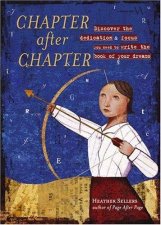
Yes, I’m a Fan Boy: Chapter After Chapter

01 Saturday Oct 2011

Posted by André J. Powell in Review, Writing

≈ Leave a comment

I got so much from Page After Page. It was not a book of technique or a step-by-step guide, though it did have exercises. It described a philosophical approach to why writers write and what it takes to be a writer. The book helped me to see myself as a writer and that I had what it took to sustain a writing life which I had unknowingly been living for years. As I read and contemplated chapter after low-keyed chapter, I began to realize that I had built up so many internal barriers and created so many false definitions, I believed being a writer was a claim only someone lucky enough to publish could make.

If Page After Page was an altar-call to be a writer, then Chapter After Chapter was a devotional, a “…meditation…”, as Heather puts it, on “…the art of writing a book.” I cannot express how grateful I am for her distinctive“…approach to a special kind of writing life” (Sellers 1). Based on my experience with Page After Page, I read each chapter with anticipation, appreciating each carefully crafted idea and observation. I found so much that resonated with me personally in each chapter, that I had to resist blasting through the whole book in one or two settings. I put the brakes on however, and took nearly two months to read it giving over time to reflect, meditate and think on what she’d had to say. As a result, even the parts that at first blush seemed unrelated to me and my experience, I nearly always found an application within.

Chapter After Chapter is divided into three parts. The first is devoted to preparations just prior to plunging into the process of starting a manuscript. The second section concerns itself with the writing of a novel-length manuscript and the unique challenges a writer faces during that stage. The third and final part offers advice and observations on the process’s post-writing phase.

The first two parts were the most pertinent to me as I’m far from anywhere near the publication stage of the process. This does not mean that I found nothing presently applicable in the section three. On the contrary, the chapters were quite informative in preview and will be invaluable once I reach that stage of the process.

In section one, I found so many rich veins of precious ore that I’m sure I will be refining for some time to come. Three chapters in particular, “Surround Sound,” “Positioning” and “Faith in Writing,” stand out in a gallery of outstanding offerings. In “Surround Sound” Heather returns to a theme from Page After Page wherein she paraphrased the age old adage that for every day a writer takes off from writing, his muse takes three. I have suffered this,  “…insidious mental weed called Creep” (Sellers 52) without realizing it. How many times have I allowed the intention to write or a specific project to ‘creep’ right out from under me until it died a hardly noticeable death? The observations and advice in “Surround Sound” gave me strategies for recognizing Creep and how to prevent it from taking over my writing garden,

“Positioning” contains great advice that bears immediate and dramatic fruit. I now position or ‘pre-position’ every night before I sleep. I open what ever Word doc. manuscript I’m presently working on, prepare new headers, label it for the next morning’s session, then reduce it to the taskbar. I open my handwritten writing log, date and time it for the morning. I might add a directional note or two reminding me of what I hope to accomplish during my morning session. I set the dogs’ dishes next to the library door where I write. Finally, I fill the coffee pot and set the timer of Oh-Dark-30 and lay out my work clothes for the next day. It is amazing how much energy this simple ritual gives my writing time from 04:00 to 05:30. As I have said in other blog entries, no other 90 minutes during the whole day is nearly as productive. If for nothing else, Heather’s advice on the how, why and wherefore of setting up this ritual was worth the price of the book.

Being a man of faith myself, I appreciated “Faith in Writing.” Its message resonated strongly with me. As the title suggests, writers must have faith in their writing and in the act of performing it. Writers work hard and quietly in monkish isolation, striving for an intangible goal, a construct only they can see within their hearts. This is as true a description of faith as I can think of. People outside writing find this odd or even irritating as we faithfully soldier on true toward our invisible goal.

The chapter further explores the non-writer question of what good is a world full of writers when realistically only a few of that burgeoning group will ever take their writing beyond self-publication? Her thought provoking and dead-bang answer taps into a part of me that responds with giddy and relieved happiness at having found a kindred spirit who ‘gets it.’ As an educator, this touches me deeply.

There were so many other insights gained from this section and its chapters: “The Book 100,” “The Burden of Being” and “Once Upon a Whine,” to name a few. My copy is covered in handwritten notes, underscores and yellow highlighter. The center section was no less insightful and thought provoking, providing immediate results. Its chapters, “Wise Guides,” “Briads” and “Stuck/Unstuck,” were exceptionally helpful.

In “Wise Guides,” Heather points out that many of us in our gushing need for guidance rush to the How-To-Write-Fiction/NonFiction/Genre bookshelves for advice, buying or checking out all kinds of books on writing. In a desperate frenzy we read about this author’s method and that author’s exercises.  I think that the very week I read that particular chapter, a parcel arrived from Writer’s Digest containing no less than three writing books, two of which began with the title: “The Complete Guide to Writing…” I nearly laughed out loud. Heather suggests in “Wise Guides” that we should narrow our choices and carefully choose but a small handful of ‘advisors’ from both the this-is-how-you-do-it camp (books on writing) and the this-is-how-I-did-it camp (books like the one we wish to write). If we try read them all, we’ll lose time for writing our own manuscripts and be conflicted to boot.

It is with unabashed pleasure that I admit to one of my Wise Guides being Chapter After Chapter representing camp one, and Robert E. Howard from camp two, specifically “Red Nails.” Her rationale for suggesting this strategy and her explanation on how to go about it lifted from me the heavy burden of knowing so little and the anxiety of failing to take in all the how-to’s before attacking my own manuscript. I felt free to pursue my writing and did not feel pursued by hounding experts baying after me,

(indent)“You didn’t read my ‘Idiots Guide to Novel Writing and Publication’…there are secrets here you must know! One false step…and it could be over before you begin!”

(indent)“You must finish ‘The Writer’s Adventure in Archetypes’ if you want to use archetypes and don’t know how? What if you do but don’t do it right!?”

(indent)“You can’t write good dialogue until you’ve read, ‘The Fiction Conversation: A Guide to Knowing If It Sounds Real,’ and done all the exercises herein. You don’t want your character’s to sound stupid…do you?!”

Stop the hurting!

This chapter helped me to shush the guilty voices in my head and to concentrate on my manuscript, Wise Guides at my side ready for a quiet consult when I needed it.

I have mixed feelings about “Braids.” Part of this has to do with where I was in my manuscript at the time I read the chapter which was right after finishing one of those it-wrote-itself sections and I was thinking ahead to the manuscript’s end game. I had already passed the mid-point of my story and it is this vast desert in the middle that Heather uses as her chapter’s a guiding metaphor. The middle of a manuscript can be a place of sun-bleached manuscript bones, a place marked with the tracks of wandering and lost writers. In nautical terms: a manuscript middle can be the doldrums. You’ve worked so hard and suddenly, poof, no steam, no pop, no interest.

Heather suggests that this is the very spot a manuscript needs some zest, an “…element of discovery…” to lift it from the sands of boredom and lethargy (149). An additional storyline might just be what the doctor ordered, adding life and a thickening to the plot just where it’s at its thinnest.

She illustrates the success of such a strategy by relating the story of a creative writing student named Christian. The point she made with his story, again, struck a cord with me and I looked back at my middle and I’ll be damned if it wasn’t strained, rushed and thin. I could see where I’d been wandering about a bit, making half-hearted attempts to find water. It needed something and I suspected I knew what that something might be.

“Braids” suggested that rushing toward the climactic moment might have been a bit premature. Though it’s good to keep the ultimate goal of a manuscript in the mind, trying to push the manuscript toward its end is not a good thing. I have found, in my limited experience, that a manuscript is organic and alive to our subconscious and there may be some unexpected growing to do in areas our conscious mind had not planned for but which makes the manuscript richer and more complete. I wonder if I did not suffer from the doldrums right there in the middle and without realizing it skated over the issue with poor writing in my eagerness to be on my way toward the end of the manuscript. Though I may have tweaked the chapter’s intent to fit my need, it nonetheless highlighted a weakness in my manuscript and a method for improving it.

“Stuck/Unstuck” afforded me concrete strategies for dealing with this writing bug-a-boo. I’m sure every writer eventually develops a tool chest of personal strategies that work for them, familiar tried and true instruments of lifting a manuscript out of a tight spot or sticky mire. I remember one particular section of my manuscript wherein I was at a critical juncture, but I couldn’t get beyond a certain sticky point in the scene to make it work. Every option either made no sense or fell flat as disingenuous.

I took the “Make a List” strategy and became Santa bloody Claus! I made a list of no less than 112 ‘ways’ to escape the trap I was in, some of them plausible some ridiculous. Key, however, was allowing the list to go where it wished and I found myself making sub lists. One of these was a list of reasons why I felt the scene’s content wasn’t working, why I was struggling. I went over the list again, crossed out the bad boys and girls and underlined the good boys and girls. From there I continued the exercise until I lit upon a solution that wasn’t far from my original yet murky and nebulous idea. This time however, it was more considered and tempered by the other ideas that came up during the listing exercise. The time it took to draw up the lists? All damn day, two counting the time I took that evening to think about the last version before my writing session the next day. The list, as Heather suggested, “…gave [me] back [my] power to choose” (168).

As I mentioned in and earlier entry, I finished my manuscript’s first draft on September 16th and am now preparing for the longer revision stage by construction an accurate outline of the story as it is now. Thus, parts of section three of Chapter After Chapter do not yet ring as truly as I’m sure they will in future. This does not mean there aren’t gems to mine…oh, no. In fact the very first chapter, “Writing Is Revising” had plenty of rough cut gemstone to contemplate.

Over and over I remind of my composition students of  that age old adage, “…great writing is not written; it is re-written, re-written and written again…” They groan and know a re-visioning of their work is on the homework slate. In this chapter Heather makes it clear that rewrites are actually a refining process similar to the process a musician or athlete goes through when they are perfecting their art. Each practice, eath go-through is a new version of the old set or exercise. There will be failures, glaring problems will make themselves known (something my students most decidedly do not want to acknowledge), but the process of trying this that ultimately fails and that which improves is like purifying gold in the fire. Writing is refined in the re-writing/re-visioning crucible. Impurities are gradually leeched out and burned away producing a subtly changed and lustrous manuscript. She makes many more amazing points, a couple of which I have to quote here for their pith and truth.

(indent)“Writing is not furniture assembly” (177). Hear-hear! By all the gods, hear-hear!

(indent)“Learning is a series of little improvements punctuated by many, many, many terrible disasters” (178). If there is one reason for present day mediocrity in so many fields of endeavor, it’s this propensity to avoid the difficult and crave the easy. Head ache? Take a pill. Weight loss? Do the same. Change the channels on the T.V.? Use the remote.

(indent)“If you wish to rise, Sextus, do the difficult,” said Ben Hur’s Mesalla. True, true.

There is more to this chapter than simply stating the obvious: writers need to re-write and re-vision. Heather offers a way of seeing revising, of working through the process, that removes it from the realm of drudgery and grind and elevates it to its proper station as a mark of the mature writer. I don’t think I’ve ever looked more forward to the discoveries I’ll make during my revision process as I prepare to separate the wheat from the chaff of my first draft.

An observation on a final chapter and then I’ll close my epic of blatant and unrepentant hero worship. Though I have a lot of ground to cover, many things to learn and an enormous amount of words to write before reaching the point of deciding if my manuscript goes under-the-bed as a point checked off my Bucket List or is prepped for a run at the ‘brass ring’, “No One Tells You,” was a chapter I got a lot from. Here, Heather points out that there are many customs, taboos and truths about the writing sub-culture, particularly about a writer’s post-publication state of being, that no one tells you about. For example, she unapologetically, yet gently, deconstructs the I’m-a-published-author-and-the-world-is-at-my-feet stereotype many of us in the unwashed masses category have dreamed up concerning how it will be after we publish our first missive. The truth is very few will walk the highroad of King, Rowling and Tolkien let along soar to the heady heights of Fitzgerald, Kafka or the Brontës.

“Writing a book doesn’t gain you entry into the Special Club of Famous Authors. Your life, post-book, looks like your life now” (223). She follows this statement with a confession of how she erroneously thought it was going to be, how she learned otherwise and a list of 11 hardcore “No one tells you…” items every writers who aspires to publication should be aware of concerning, “…author etiquette…” and “…how to market your book” (225, 227).

One of the many gems in this chapter was the humorous-because-it-is-too-true paragraph that starts out, “Reality check: The club of people interesting in books and authors is pretty small. That’s why most of your co-workers and friends can tell you who wan the last American Idol, but they don’t know who won the last National Book Award (224). Tragic and true (by the way, that would be Jaimy Gordon for Fiction; Patti Smith for Non-fiction; Terrance Hayes for poetry; and Kathryn Erskine in the area of YA fiction for 2010.

As time goes on and I pursue my writing craft, I know I will come across other experts in the field whose advice and suggestions illicit from me epiphany-al moments and similar blatant admiration…maybe. My reaction to Heather’s observations may simply be a case of my effective filters having never been provoked by her style or the synchronicity of the right things written for me to read at the right moment in my life. I also acknowledge that what I understood and what Heather intended might not be the same either. All three are probably true, but what is also true is that I know I will return to her guides often; indeed, she will likely be one of my “three wise guides” from now on. And I’m sure I’ll gain even deeper insights into the craft, art and philosophy of writing and how they might be applied to my own humble attempts.

Originally posted in The Salamander’s Quill 1.0 now deleted.

The Kevodran 2.0: The Desert Looks Different From Here

19 Monday Sep 2011

Posted by André J. Powell in Retrospection, The Kevodran, Writing

≈ Leave a comment

As noted below, I reached the end of The Kevodran manuscript with version 1.70 on Friday, September 16th. Now that the first draft is finished the question of, “What’s next?” must be addressed.

The manuscript is far from ready to put to bed, or retire under-the-bed for that matter. In fact, save for the NaNoWriMo (National Novel Writing Month) in November, I think the rest of the school year will be dedicated to developing and polishing The Kevodran, at least until summer arrives. At that time, I hope to return to November’s efforts and pursue The Three Moon Maidens.

This plan may be problematic as we will most likely be moving from my beloved Iona Cein, my beautiful home, library and back yard retreat, to some godforsaken rental having let the house “go back to the bank” as they say. It is definitely not something I want to do, but life is what happens when you wish it wasn’t. If the drama of it all interrupts my fiction’s muse and writing practice, I’ll make the best of it and compile a set of notes and journals concerning the loss and the emotional toll of leaving a place beloved, the humiliation of foreclosure, the symbolic and spiritual meaning of home, the dehumanizing aspect of the situation, and the fear of ‘starting over’ at 50 knowing that I most likely won’t live long enough to have a home of my own again. This, I believe, might provide some wonderful raw material for a small manuscript of poems and prose vignettes on the subject I’ve been considering in the back of my mind for some time now.

If I can, however, I’d like to keep the momentum going with the The Kevodran, despite my present lack of publication ambition. I have learned so much during the writing of this first draft. I’m sure the next stages of additions, re-writes and revision cannot help but teach me more about my practice and the craft. Who knows what amazing things I might discover over the next nine months?

My present plan involves a set of revisions. Each will focus on a major addition or re-write.

The Kevodran 2.0 would be a cleaned up version of the story and arguably the most critical of the versions as I plan to go through the manuscript and create a detailed plot outline from it. Though I, of course, had an outline to guide me during the initial writing, the organic nature of composing a novel-length manuscript took the story in unexpected directions. I need those surprise paths recorded and mapped out. A companion document dedicated to such an outline would help immensely as I try to see my plot line clearly.

I also plan to address all the “Notes”  placed in the manuscript reminding myself of this needed addition or that important clarification. I hope that by doing so the manuscript will smooth out a bit and add a sense of euphony and continuity to the whole.

Once that is done, 2.0 will be complete.

The Kevodran 3.0 will focus on adding the character Orrja’s story to the plot. Heather’s Chapter After Chapter section “Braids” put a bee in my bonnet concerning the importance of giving a story depth and interest via additional POVs or story lines. In the beginning, Orrja was a rather flat and static supporting character. As the story progressed however, in one of the unexpected developments mentioned above, she became extremely important and almost a main protagonist herself.

I hope that having explored the main events of the plot in The Kevodran 1.0, weaving in Orrja’s story will be less problematic. That being said, I have no doubts the story will be pulled in many new, strange and wonderful directions that may then require their own serious revisions.

The Kevodran 4.0 will add a third strand to the braid with the addition of Selt’s back-story and his point-of-view. As this will be an exploration and less of a sure thing than Orrja’s tale, I will have to be very careful the story does not take off in a new direction. Selt has ever been the main character’s side kick, but he is his own character with equally as strong motivations. I could easily imagine his time with the demon Golden August being an amazing story on its own. If not the subject of a full length manuscript then at least a short story’s worth of material. I’m open to additional revelation, but I don’t want The Kevodran side tracked too far.

The next version, 5.0 will involve a process similar to that of 2.0 with a smoothing of the manuscript and a nudging it into shape before the true rewrite effort begins. In my mind this will produce a truly finished first draft with all parts present, all ideas added, all twists and turns completed, something I can take a proverbial editing hatchet to in the next incarnation.

The Kevodran 6.0 will then be the true revision. I would like this version to end up being not only smoothed out, but trimmed down by quite a few words and given a serious critique. I will give this version over to all the self-editing and revision skills I have in a ruthless appraisal. Everything undergoing an honest evaluation. If something doesn’t further the story along, it will be chopped. The remainder will again be re-aligned, smoothed out and evaluated for euphony and continuity.

7.0 will be the “Reader’s Version.” This is the one I will offer to a Writer’s Group, a Writing Conference One-on-One session or Reader critique for comments. The observations and suggestions offered by those readers will be evaluated and either disregarded or employed as their merit indicates. This will, of course, lead to an 8.0 version which would be the next “Reader’s Version” and thus begin a cycle of refining rewrites.

Somewhere down the road, if the manuscript really even makes it that far and hasn’t long before been put to rest beneath the bed, it will be as ready as it can be for professional rejection. Will that be 9.0 or 12.0 or 20.0? Who knows? Regardless, by that time, I’ll have my intro chapters and a detailed outline ready, probably a polished query and all the other silliness required for publishers to sniff over the carcass. I’ll then send it out into the world and see what happens.

After that, of course, if there is any interest in the tome at all, there will be other revisions as various professionals in the world of modern literary publication all have their crack at the manuscript.

Again, this doesn’t daunt me. I’m sure at such a time, I’ll feel like any other writer: eager, anxious, disappointed, elated, rejected, harassed, etc., etc. But really, as Beowulf said, “Fate goes ever as it must.” In other words, what is going to happen is going to happen…or not.

In the mean time, I’ll be working on my next manuscript which, I have no doubt, will also end up like the first: in a place of honor under my bed. Still, I look forward to the ride and all I will learn in the effort. Hopefully, as a result, each manuscript will be better than the last.

In truth, what really matters is that I write and there is so much of it to do, most of it having little to do with editors, agents and publishers and everything to do with pursuing my passion

Originally posted in The Salamander’s Quill 1.0 now deleted.

I Have A Crush On Heather

17 Saturday Sep 2011

Posted by André J. Powell in Review, Writing

≈ Leave a comment

I bought Page After Page, read the first chapter or two, got scared and left it on my nightstand untouched for nearly a year. The cover freaked me out, the writing style had an odd air to it that didn’t sit well with my sense of composition, and, I told my self, the first two chapters were all too familiar…sounding, on the surface, like a repeat of “You can do it!” rah-rah. The truth was, I was terrified…terrified because I could feel the truth in the vibrations of Heather Seller’s words as they plucked at the strings of my writing subconscious. I believed I sensed that I was about to be challenged with truth, and, for whatever reason, maturity, age, experience, circumstances, forced to confront it and make a life-change decision about whether or not I was a Writer (note the capitol ‘W’) or someone who simply writes about wanting to be a Writer.

When I finally got over my fright and more than a year later blew the dust off the cover and cracked the tiny tome open, yellow highlighter and mechanical pencil in hand, I discovered, as I suspected I would, not a book of ‘how-to exercises,’ though there are writing exercises throughout, but a book of seeing, a book of truth, a book of mirrors. With each chapter, “Lover on the Side, Lover in the Center,” “Butt in Chair,” “Being Away From the Work,” “How to be Unpopular and Why,” and “When Do You Say It?” to name a few, I was forced to confront my assumptions, my delusions and my purity-of-intention in terms of my ‘writing life’ and by the time I ended the book, I can honestly say my entire attitude and vision had been changed. If it sounds like I had a spiritual experience…at the risk of sounding dramatic, I’m going to say, yes…yes, I did—especially in terms of a deep inner adjustment and outward life-style change.

70 days after reading this book, and others that came a long including Heather’s Chapter by Chapter (Hail Oh, “Six Wise Guides”), I began and finished the first draft of a novel length manuscript. Do I lay this heretofore un-accomplished ambition on Heather’s altar, pouring out libations to my new found Writing Goddess? Of course not, I’ve been writing for most my life and have been Jones-ing to write a novel length manuscript for some time. It was inevitable I would eventually succeed on some level. I would be less than honest, however, if I didn’t say that her philosophy of what a Writer is, how our sometimes faulty perceptions influence that belief, her thought provoking essays on the process and craft of writing were vitally critical in helping me to that long cherished yet unfulfilled goal. It would not be too much to say that without her thoughts, I would still be dreaming about writing a manuscript and not actually writing it. Nor would I refuse a drink with the lady and, in the spirit of present honesty, I will admit to a certain crush on the lushishly long haired writing guru.

This does not mean I agreed with everything she had to say or am now the prophet of some ultimate “Way of Heather.” Some of what she had to say simply did not apply to me…yet. My present experience and place in life left some of her chapters a bit less applicable than others. “The Rents” for example, and its references to the, at times, negative influences our parents have on our writing did not jive with my experience (though that chapter’s exercise about “Adding new parents…” and exploring the influences of our favorite authors was well worth doing and gave me a lot to think about…and yes, I added Heather to my writing family tree…lol). Other’s however, like “Lover on the Side, Lover in the Middle,” “Butt in Chair,” and “When Do You Say It?” rang like dinner bells in my inner ear and forced me to confront my own writing practice and perceptions.

This is not a self-help book however, and I hope I have not made it sound like such. That being said, it is a book that helped me toward a greater awareness, confidence and belief in my persona as a Writer and the only such book to speak to me on a level and in such a way that I could understand that indeed, I am a Writer…despite the fact that the cover creeped me out.

Originally posted in The Salamander’s Quill 1.0 now deleted.

A Bit Squishy Yet Ultimately Satisfying

01 Thursday Sep 2011

Posted by André J. Powell in NoWriMo, Retrospection, Writing

≈ Leave a comment

The AugNoWriMo was successful, and though it did not have the same exciting “first-timer’s” crunch that the July experience did, it was nonetheless a wonderful experience. A HOL acquaintance, who will remain nameless, disparaged the July challenge in favor of the August one. Rather rude considering I was excited about the July challenge which had only just begun when I mentioned my ‘newbie’ participation in the HOL chat-room. This is an irritating hazard about ‘online-arms and armor’ when worn and used by folks with little or no communication skills and lousy effective filters. They say shit that is dispiriting and simply boorish.

I can only imagine the thinking process behind the pronouncement, “Oh, this guy is trying his hand at a NoWriMo. He seems excited. It’s his first time. I’m excited too! I remember my first time. I’m excited about the August challenge. I have a computer. I am online. I’m in a forum. I can use emoticons. I plan to write for the August challenge. It’s better than the July challenge because that’s the one I’m in and so is my friend ‘X’. We have done it before. I’m a veteran. I know a lot. I’m going to tell him what I know and declare that I know it to all my chat-room peeps. They will be impressed.”

The basis for this judgment may have had to do with a few of AugNoWriMo’s unique features.  Rather than a mandatory 50k, writer’s can set their own word-count goal. Almost anything is acceptable from five to 100K or more. AugNoWriMo writers may also work on multiple manuscripts as long as the final work count matches their declared goal. Should things take a turn for the worse, the goal can be re-evaluated and changed, up or down, in increments of five K. The AugNoWriMo also offers a unique publication option in its compendium of short stories, Milestones, for those interested in seeing their work in print. All in all, it’s a good set up and run by some enthusiastic mods. I look forward to receiving my reward certificate via email sometime in the near future.

The certificates are worthless in the sense that they mean little save to those who participated and met their goals. For me they are an important symbol of my accomplishment, level of commitment and discipline. I purchased my trophy coffee cup, a tradition I started with the JulyNoWriMo and plan to continue. I ended up designing my own as there was no Café Press store link posted on the AugNoWriMo’s site. More important than certificates and coffee mugs however, I came away from this experience with long-term rewards and signs of achievement: knowledge.

I learned that the 50K+ of the JulyNoWriMo was not just a fluke or the happy result of a lucky month. I can, with discipline, sustain a viable and productive writing practice every day (so far).

I learned that I can make my, ‘2K a day’ word goal despite working full time, at least with a vacation’s head start to get my momentum going.

I learned that my golden hour, discovered when school started, is from 04:00 to 05:30 when I have to put up the pen and get ready for work. This truly was an epiphany-like discovery for me. Before work, I can crank out up to 1,600+ words in that 90 minute period. The same amount of time at the opposite end of the day, 16:00 to 17:30, results in less than 700 words. I believe this is due to two factors. One, if I have “prepositioned,” (Thank you, Heather Sellers!) before bed, crashed around 21:00 and got about seven hours of sleep the night before, I’m fresh. My mind is unclogged, and after a sip of coffee or two, the words flow like water. Two, I know that in 90 minutes, I MUST put the pen down or I’m going to be late for school and I need that hour of prep before my students arrive for class. This keeps me focused and productive.

Thus, while the JulyNoWriMo helped me to an understanding that I can write a single 50k manuscript in a month, the AugustNoWriMo helped me realize I can sustain it for more than a month and  do this while working full time.

I suspect that every time I take on such a challenge, I will learn something new about my practice and the craft of writing.

I am tracking my progress during the month of September without the incentive of a NoWriMo to encourage me. I will finish the first draft of The Kevodran during this month and will have to augment my word count with blogging, background development, HOL extra-credit and letter writing.

Originally posted in The Salamander’s Quill 1.0 now deleted.

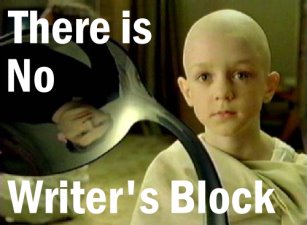
There Is No Spo…er…Writer’s Block

09 Tuesday Aug 2011

Posted by André J. Powell in Observation, Writing

≈ Leave a comment

I know some might argue with me, and rightly so, but when it comes to the issue of “Writer’s Block,” I’m not sure it isn’t more myth than reality. That being said, I will admit to having been blocked, backed-up and to have suffered from the lack of a literary movement from time to time, compositionally constipated as it were. But blocked, as in NO MORE WORDS, IDEAS, COMPOSITION? No…no, I don’t believe I have. In this “Summer of Writing Furiously,” I have come to a few conclusions about my present-writing-self, particularly in the area of the phenomenon of writer’s block or as I prefer in relation to myself: a writer blocked.

There are times when I am slow to start. I sit in front of my computer, my preferred writing mode, and sigh deeply wishing the coffee would kick in, secretly wondering if it ever really does, loath to begin. I watch my Widows Sidebar gadget that monitors computer activity as the squiggly little lines jump up or dig deep, an apt brain activity metaphor.

There are times when I don’t feel like writing. I’m contemplating the next scene on the plot hit-parade, a problematic one I’ve yet to work the logic out for, and I feel like my energy levels completely inadequate to deal with it. I feel my machine is an energy vampire sucking the life and creativity from my finger tips and eyeballs.

There are times when thinking or talking about writing is so much more fun than actually doing it. I go over plot points I like or talk to myself (a viable strategy by the way, which I use constantly to the bemusement of all who know me and wariness from those who don’t) about this protagonist’s motivation or antagonist’s inspiration, convinced I’m refining, but actually only reminding myself of what I already know. I’ll talk about my [trivial] insights and [not-so-momentous] literary discoveries to my indulgent wife ad nauseam until she drifts off to her study to play solitaire (a sure sign she’s done listening).

There are times when I allow myself to be distracted. “Calgon! Take me away!” (Damn if I didn’t just date myself). I check my email or visit various forum’s where I’ve posted and end up writing “important” letters or responses. I review my blog updates and visit author sites getting mentally involved with what’s happening in other writers’ and would-be writers’ lives purposefully ignoring my own.

There are times I’m desperate for an idea—an idea needed to further the plot along, provide motivation for a character’s action, a way to get the story from point A to point B—and I feel completely clueless how to find one. I don’t know what to do and desperately turn to a likely reference book or inspiring novel for guidance, or make myself something to eat, or play a tune on my practice chanter, or hangout with my dogs. (Indent)There are times when I feel I simply cannot approach my main plot again until I have more deeply explored some aspect of background material. I stall the plot and my characters while I establish the naming practices of a certain culture, or decide how bricks were actually made in ancient “X” before allowing my protagonists to enter the “great and grand City of Trumpeting Towers.” I mean how the hell am I supposed to describe it if I don’t bloody know what a “Trumpeting Tower” is?

There are times when I’m just flat depressed, completely without hope that I’ll ever establish a writing life up to snuff. Every other writer is cooler than me. Every other writer is smarter, more intuitive than me. I’ll never be like my “Writing godfathers and mothers.” I’m too old, too set in my ways, too put upon, too financially dependent, too ingrained with bad habits, too slow to even day-dream of being a writer let alone waste all this time and energy on what is essentially a pot-of-gold at the end of the rainbow or a lottery crap-shoot.

All this has as a source, I suspect, not so much an all encompassing writing affliction as it does my choices and my reactions to the choices of others. What was I doing the night before my blocked writing session? Let me see…

  • Was I waxing nostalgic with my brothers, drinking scotch (Slainte!) and am now hung over, tired and depressed about being 50?
  • Did I stay up with a late night “block buster” movie and could not fall asleep because I was upset with the ending and the shit-poor story-telling Joe-public so blithely accepts and perpetuates?
  • Are my bagpipe passions inflamed after an amazing lesson with Aaron and all I want to do is make music for awhile and pursue that artistic endeavor?
  • Has BoA collections called again demanding repayment, threatening eminent foreclosure and financial ruination and I’m feeling a little distracted about the future?
  • Has the district office sent their end-of-the-summer letter signaling an oncoming tide of bullshit or has Michelle Malkin once again disparaged my chosen profession making me feel like the state of American young people is all my fault?
  • Can I hear my wife trimming a hedge in the yard and am I feel guilty for neglecting what “normal” people do not?
  • Am I in Perfection-Man mode after having read an accomplished author’s work that blew me away and am now convinced that nothing I do is good enough?
  • Did my brothers just email me with a, “we never get together now that you write all the time” missive and as a result, I’ve plunged into research mode, donning my pseudo anthropologist-archeologist explorer’s hat preparing for a weekend game and grill session?

All these circumstances, and probably hundreds more I have yet to identify, and responses are at their roots self-perceived and self-imposed. They reminds me of a time when sitting at the local pub, I watched two of my companions throw “blocks” at each other as they vied for the attentions of a certain lady. Attack and parry, counter-strike and riposte, it was an amazing fencing match between masters of different styles.

(Indent)“Oh, hey, isn’t it about time you called your girlfriend?”

(Indent)“Dude, that was insensitive of you, and I might add, a rather childish; you know she left me a year ago.”

(Indent)“Well, then who were you talking to earlier by the name of “Baby”?

(Indent)“Dude, I was talking to my sister about her baby, hello; do you got somethin’ against me checkin’ up on my niece?”

(Indent)“Oh, baby, don’t be that way… you talk to your sister like that? Man, that’s just sick…”

The blocks come and I respond…usually in a way that precludes actually writing. And therein lies both the problem and the answer I have found to these Writing Blocks and that is simply more writing. Amazing and as paradoxical as it is, yes, more writing. (Indent)In each and every case cited above, the best answer I found, the best response was butt-in-chair, eyes-on-monitor, fingers-on-keys, now write! Write! Write!

Oh, the agony! I write drivel and I groan. I write out complaints and I whine. I write poorly and I cry. I write of nothing and I sink lower. I write of something totally unrelated and feel guilty. I rail at my characters and they rage back. I write out lack luster dialogue, stupid descriptions that make no sense, add details that are needless and inconsequential and then delete or strikethrough it all and begin again. Eventually, by some amazing unexplainable means, I slowly emerge, gradually materializing like a soldier from the flash and smoke of my verbal battle bearing the colors of true composition—if not necessarily inspiration but true writing nonetheless.

It is painful and no fun, but I know if I do not sit and start despite the discomfort, then one hour becomes two; two hours becomes a day; a day so, so easily and slyly becomes three and then I am truly screwed. For as Heather Sellers paraphrases the famous quote it in Page After Page, “If you take one day off writing, your muse will take the next three.”

Thus, for the present “me” at least, there is no writer’s block so much as self-imposed writing blocks that must be powered through, ironically, only with more writing.

Originally posted in The Salamander’s Quill 1.0 now deleted.

“Momma says he’s bona fide…”

04 Thursday Aug 2011

Posted by André J. Powell in JulNoWriMo, Observation, Writing

≈ Leave a comment

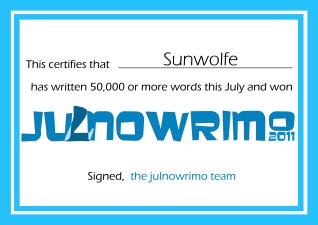
It is something; it is nothing; it is everything. There will be no place for it save in my cyber scrap book. It will never be framed and placed on the wall next to my degrees or credential, but, nonetheless, as whimsical as it is, as easily “forged” as it could be, I will not be able to look at it without associating some deeply cherished hopes and very real blood-sweat-and-tears with the effort it represents. It is more than a 50k+ attaboy. It represents passing a test: can I write a novel-length manuscript; can I do this thing that I have talked about doing nearly all my life? No certificate would have meant, “not this time” or maybe not ever. The parameters were self-imposed but no less stringent than those placed on a creative writing major working toward an MA. From that perspective, the whimsical blue and white certificate may therefore mean more personally than my college degree, for in this instance no professor, no curriculum, no colloquium could have been as demanding, exacting and critical as I myself was.

The August NoWriMo effort then represents a different test and, if passed, achievement. Can I write, with a running start of two final weeks of vacation, 50k+ of a manuscript while resuming work at the same time? In addition, can I actually finish a manuscript (the first draft of The Kevodran should be finished within the next 20 to 25k words)? Knowing my vocation as I do, this will be very difficult. Ironically, there is no sympathy for a secret life of letters even in an English department. Your total devotion is expected; your total sacrifice presupposed. Even as I am in the first movements of that trial, it is proving problematic and I find I am having to refine my “butt-in-chair” or “eyes-on-the-manuscript” skills as the aegis of July’s success lulls my focus.

The National NoWriMo in November is what might be considered the trial by fire, the last measurement and confirmation that my secret life of letters has a chance of not being so secret forever. Can I in the midst of a full working month, with a serious family holiday in the mix to boot, produce 50k+ of a manuscript? If I can pull that off, if I can make it through the demands of that challenge, with mondo-housecleaning to do and turkey, gravy and stuffing coming out of my ears, well then, the last excuse is laid to rest. Nothing this side of true physical or psychological disaster should stop me from writing novel-length manuscripts. It is something I will know in my bones and baring said disasters if I do not pursue it, it is because I am not a writer at heart.

Some may argue that whether or not I’m a writer is not subject to such subjective measurements, that it is something one intrinsically is and knows they are. I suppose, from a certain perspective that is true. Even if I do not produce novel length manuscripts, I will continue to write in my journals, editorialize in my secret blogs, write background material for my fairy-milieu and maintain my creative responses at HOL and by extension fan-fiction in JKR’s world, or JRRT’s, or GL’s. That however, to me, is not the same as the ambition to write original novel-length stories. I argue that it is a different breed of hound altogether and I need to know, must know, within and for myself if that dog will hunt or not. If I have tested myself most thoroughly then I can either without regret lay the ambition to rest or pursue it with a vengeance.

Tally-ho!

Originally posted in The Salamander’s Quill 1.0 now deleted.

The Library At Iona Cein

03 Wednesday Aug 2011

Posted by André J. Powell in Retrospection, Writing

≈ Leave a comment

Now that it is almost over, I look back on my summer and realize what an extraordinary time of writing it has been.

I have “learned” what I already knew subconsciously—that though I may never publish, though nothing of my work will see print this side of my own desk-top, though few but family will every even hear of the stories and essays I write, I will continue to write until the lights go out. It is what I do and part of my personality. That is something no one will ever be able to take from me. If I have no computer, I will compose on plain paper and in longhand. If that is taken, I’ll use scraps of paper, the insides of shopping bags, “paper please,” or the back of envelops and receipts for as long as they last. Take it all away and I’ll still write and my mind shall be my parchment, my imagination shall be my quill. I must write…and read. It is truly like eating and drinking.

I wrote in my home library, my wonderful amazing inner-sanctum of books and swords and musical instruments and art and cushy chairs. It was a perfect place to write. I have a faux fire place and early in the summer as I was beginning The Kevodran, it was cloudy and we had some oddly-chilly days. With my Pyrenees-wolfhound mix stretched out before the “burning” fireplace, baroque music playing softly, my fingers briskly tapping away, an anxious muse feeding me lines, reference books tilted open to my right and left on make-shift book stands, I was so living the dream. Not all the illusionary materials were in place. My “Persian” carpet was a cheap ‘Bed, Bath and Beyond” knock-off and my worn chairs were not leather clad  wing-backs, and instead of wood paneling I had to settle for a horrific mottled wall paper, but rising from my broken office chair to open the door to the side yard so could listen to the rain fall, it was as perfect as I suspect it is ever going to get for me.

It’s why I am so sad. Next summer will be one of chaos. We will be moving away having let the house go back to the bank six months earlier and thus, it will no doubt more resemble a military staging area than a home. We bought during the high tide of the market, believing we’d be able to refinance and live out the rest of our days, if not in comfort, then at least in settled contentment. Like so many others, however, when the tide receded, we were left with an approaching dooms-day nothing this side of a miracle or a sympathetic and honest lender—an extinct breed—could forestall. I will not bore what few readers I have with the details. If they want to know specifics, they can pick up a newspaper. My story is not unique. We gambled and we lost. We’re upside down and the only way to right ourselves is to leave.

Leave my perfect writing environment, my idea of heaven. Thus, my summer has been an odd mix of emotions: sadness at the impending loss of my beloved library yet triumphant at having completed a major writing challenge—sorrowful that no other manuscript will have the benefit of this sanctuary, but happy that The Kevodran at least was completed here. I realized in this room the dreamy suspicion that I am capable of a novel length manuscript. I know now that there will be other manuscripts and stories to add to my collection. Moving up the literary food-chain, as it were, of manuscript writing: from background essays, to short stories, to novel length plots, has been a delightfully hard experience. I will be forever grateful for this room just as I will forever miss it.

A neighbor once told me that his house had built up, “…a lot of good karma…” I didn’t know if that was true or not at the time. Now I know it was. Iona Cein, I named the place, “Far Iona” in the Gaelic. And like its island namesake, it is a peaceful, serine place, a true haven after long days at work, a playground for my granddaughters with mysterious and twisted almond trees for climbing, a blue pool for swimming and koi pond waterfalls singing lullabies through the open French doors at the end of the day.

We have left our mark on it; no doubt about it. The pond will undergo some major and expensive repairs this weekend. The pool has a new bottom. The watering system is nearly useless. Marirose’s Himalayan has rendered the garage a class one bio-hazard. There’s dry-rot in the eves left by former owners and the plants show the wear and tear of our awkward attempts at what I call “green-thumbery.” Despite that, I would have to agree with my neighbor; it was full of good karma and this summer it blessed me with a swan-song outpouring of it. I hope I have, by turning that good karma into meaningful self-discovery and concrete literary progress, generated more and given it back. I pray to God,\ that the next owners will find a gift of positive energy left for them and that they appreciate this place even though we were forced to leave its tranquility with such heavy and broken hearts.

When school starts in a little more than a week and I’m asked, “How was your summer. Mr. P?” I’m not going to go into details, but I am going to say, “It was wonderful. It feels like we made a lifetime of memories in a single summer! How was yours?”

Originally posted in The Salamander’s Quill 1.0 now deleted.

A Quill-Driver’s Albatross or Why Blog At All?

01 Monday Aug 2011

Posted by André J. Powell in Observation, Writing

≈ Leave a comment

The question of blogging is particularly sensitive for me. I certainly can spend my time more productively elsewhere. Even now my manuscript is screaming at me, “Only 1643 words, you fool! Get to it before the phone rings, the world ends or you ‘remember’ something else to Google!” and my timetable list lays open next to me like Exhibit A in my personal why you should be working on your manuscript trial. Being completely honest, I have to admit that I do know why, or at least suspect I know, but the answer is such a study in irony and paradox, such a comment on the health of my inner landscape, that I’m embarrassed to lay it out on paper to confirm itself in undeniable black and white.

The truth is, I yearn to make contact with the outside world or at least others who have my same sickness. Writing is a lonely passion and my family, as loving and kind and encouraging as they are, simply doesn’t have time for my scribbling. Here, however, is where the irony starts. I don’t want them to read my blog because if I know they are reading it, I will write with them in mind and therefore differently. In a sense I will assume a handicap, a disguise, a false voice and be less than truthful, worried about reactions and feelings and misunderstandings. Hell, I don’t even write in my handwritten journals any more for fear that when I die and my daughters finally read them they’ll say, “Wow. Dad was a pretty unhappy guy, and rather obsessive about certain things.” I want their notice, but I don’t want to know they’ve noticed. Sigh. Pathetic.

So I blog for the unknown masses. An unknown and faceless wannabie writer safe from flesh-and-blood critique and censure. Well…not quite. Uh…you see, I might publish my blogs out there in cyberspace, but ironically I’ve got them locked down so tight no one can see them or find them unless I invite them or they type in the URL by chance or use of Arrakin melange. In essence there’s not even a remote chance someone will stumble across them. No. Not one. They’re a Dixie Cup floating in the Atlantic.

Why!? I suspect that it is all a mental game. It makes me feel like I’m out in the public eye without really being out in the public eye, without feeling naked. It makes me feel like I’m risking contact without really risking anything. I might say, “Oh, yes. I have a blog,” or “The other day, I wrote in my blog…” but it makes my heart beat with anxious anticipation. What if they ask me for the URL? What will I do? Do I want them to ask? I suppose I do or I wouldn’t have mentioned it, would I? Then why am I so relieved they haven’t asked? As I said above, pathetic.

Eventually, I’m going to have to put up or shut up—my new mantra. Either it all stays in my personal journals or I open up and risk contact which is what I secretly yearn for but am too afraid to risk. Embarrassing to think my ego is so fragile.

Cruising the WriMo profiles and checking out the sited blogs is an odd exercise in déjà vu. Are the sites anything more than an echoing self-diagnosed and prescribed therapeutic attempt to vent and feel validated in a world that either applauds their uniqueness if it happens to be something others wish they could do but cannot or damns them for not being odd enough. Are they not simply safe ways to holler, “I am geek/nerd/mutant _____ (fill in the blank with your own noun)! Hear me roar, you bastards!”? Aren’t they simply the quintessentially statement of paradox: I’m alone, strange, rejected and misunderstood er…uh, just…like…you. Am I just adding to that echo, essentially posting a blog with hidden links to other blogs where it’s all been said before? Oops, so much for being unique.

After all these years, is that what I’m essentially still doing? If I write it and no one knows or reads it, then I am unique and safe, but I am also alone and unconfirmed, under a self-imposed sentence of exile. But if I don’t want feel alone, I have to open it up and run the risk of discovering there are others just like me and that I’m not as unique as I wished! Around and around and around it goes, where it stops, no one knows.

Wow. I have to stop teaching high school. I should just blog and reactions be damned. Hmmm…

Okay, then…damnit. Screw this embarrassed closet narcissism! Cease this compositional masturbation and let’s have some epistological intercourse! I getting some protection and heading for the green light district!

Welcome to the first openly blogger post of Sunwolfe’s The Salamander’s Quill.

Originally posted in The Salamander’s Quill 1.0 now deleted.

JulNoWriMo, Mission Accomplished!

31 Sunday Jul 2011

Posted by André J. Powell in JulNoWriMo, Observation, Writing

≈ Leave a comment

Well, I made it to my personal JulNoWriMo goal of 62,174 words and I’m pretty pleased. No, I’m bloody amazed and giddy and so, so very happy. Not only does it bring the present manuscript grand total to 74,489, but it represents a serious milestone for me. I know know…KNOW…I can. Armed with that undeniable knowledge, I can’t say can’t anymore.

I know a lot of folk are relieved when they reach the 50k mark, proud of their achievement for sure, but happy nonetheless the pressure is off. I know this because I’ve been checking out their blogs XD , but for me reaching my goal simply inspires me to keep on writing, not necessarily more, but to pursue the story to its end. Rather than relief then, I’m stoked and feel a giddy eagerness and look forward to continuing on, further developing my stories, my characters and myself.

The whole WriMo experience was really a self-imposed test to see if I could produce enough, get involved strongly enough, stay disciplined enough to write a substantial manuscript. I’ll not call it a novel as it’s far from done. Because of that however, I’ve signed up for the AugNoWriMo so I can do just that. At a rough guess, I’m going to say I need another 20 to 25k to finish the manuscript? It think however, I’m going to commit to 50k more. Like I said, The Kevodran will be done in half as many words, but for the remainder I’ll get Three Moon-Maidens of the shelf and continue with that manuscript to finish out the 50k.

I suppose this will be another self-imposed test in the sense that with school starting right in the middle of the month, I’ll have had two weeks of fairly uninterrupted writing time, honey-dos and leaky koi pond aside, to finish The Kevodran (fingers crossed). The last 25k, however, will have to be accomplished with the pressure of school dominating my time. Can I handle that 1613 word-a-day minimum and be a good husband, do my job, handle the commute,  practice my pipes, walk the dogs, have Quiet Time and get some sleep?

I guess, I’ll see.

Originally posted in The Salamander’s Quill 1.0 now deleted.

← Older posts
Newer posts →

Unknown's avatar

A wanna-be writer and sometime poet trying to live, love and learn as much as I can with the time I have left.

Recent Posts

  • How?
  • NaNoWriMo’19 Day 1: 1292
  • NaNoWriMo ’19
  • Outlining: What-If Exercises and Variants
  • I’ve Decided to Set Aside WIP 6.1

Archives

Categories

Artist blogs

  • Gracesidhe Decorator, writer, model and librarian!
  • Ravven's Glass Amazing wirter, artist and friend
  • Story Monster Storytelling at its finest–Heather’s site never fails to put a smile in my heart!

Blogroll

  • Magical Words A fantasy/scifi author group
  • Sword and Laser Online book club
  • The Office of Letters and Light NaNoWriMo parent organization
  • The Piper Who Came of Age Too Late My bagpiping blog
  • The Slootsian Dialectics Wizard and scholar-piper

Writer blogs

  • Ink-stained Daydreams The writing blog of Justin Beeman
  • Invisible Ink The fantasy and writing blog of Whitney Carter
  • Story and Somnomancy Writer, Good Friend and Ravenclaw princess

Writer Guru

  • Pocket Full of Words Holly Lisle: author and creator of How To Think Sideways

NaNoWriMo 2017

NaNoWriMo 2013

NaNoWriMo 2012

NaNoWriMo 2011

JulNoWriMo 2011

So Say We All

read the printed word!

Goodreads

Enter your email address to follow this blog and receive notifications of new posts by email.

Join 61 other subscribers

Meta

  • Create account
  • Log in
  • Entries feed
  • Comments feed
  • WordPress.com

Blog at WordPress.com.

  • Subscribe Subscribed
    • The Salamander's Quill
    • Join 61 other subscribers
    • Already have a WordPress.com account? Log in now.
    • The Salamander's Quill
    • Subscribe Subscribed
    • Sign up
    • Log in
    • Report this content
    • View site in Reader
    • Manage subscriptions
    • Collapse this bar
 

Loading Comments...